
Best Fence Styles for Privacy at Your Home
A privacy fence should do more than block a neighbor’s view. It should fit the way you use your yard, hold up through Southeastern Pennsylvania weather, and look like it belongs with your home. The best fence styles for privacy balance coverage, durability, maintenance, cost, and curb appeal - not just the tallest panel available.
For many homeowners, the right answer comes down to what sits around the fence. A shaded backyard with mature trees has different needs than an open lot exposed to wind. A pool enclosure, pet area, patio, and side-yard boundary each call for a slightly different approach. Starting with the purpose of the fence makes the style decision much easier.
Best Fence Styles for Privacy: Start With Coverage
A true privacy fence generally uses solid or closely spaced boards and panels that limit sightlines at ground level. Height matters, but it is not the only factor. A six-foot fence is common for backyard privacy, yet a lower fence on a raised lot may still leave neighbors looking directly into your outdoor space. Conversely, a carefully placed five-foot fence with landscaping can create a comfortable, enclosed feel where taller fencing is not allowed.
Before choosing material or design, consider where privacy is needed most. If the main concern is a patio, the fence line may need extra attention near seating areas rather than around the full perimeter. If you are enclosing a yard for children or dogs, the gate, bottom clearance, and strength of the posts deserve as much thought as the panels.
Local municipal rules, HOA requirements, easements, and property-line locations can also affect height, placement, and style. These details should be checked before materials are ordered or holes are dug. A fence that looks right on paper can become an expensive problem if it crosses a utility easement or exceeds a local height limit.
Wood Privacy Fences: The Custom Classic
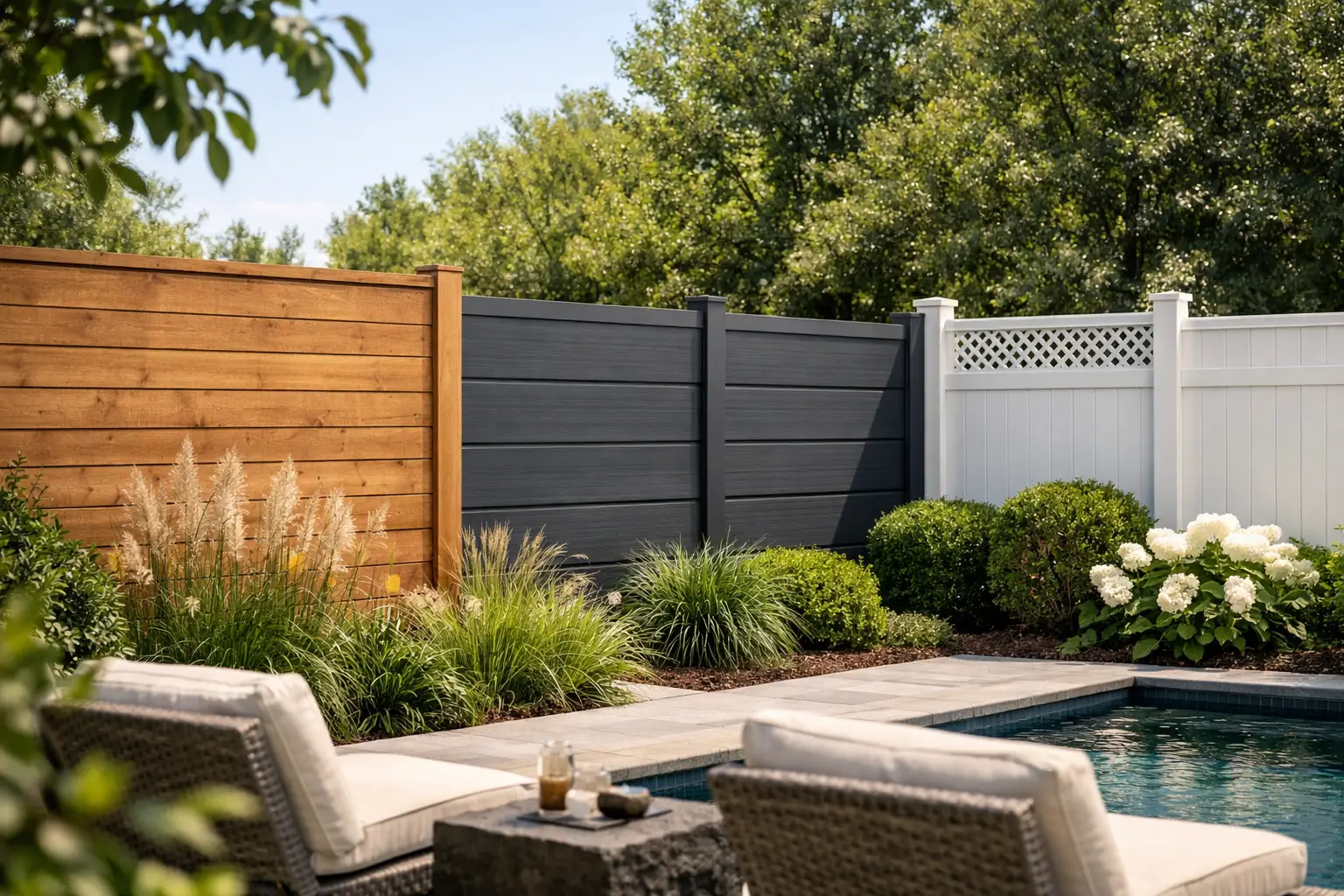
Wood remains one of the most flexible choices for homeowners who want a custom look. A standard board-on-board fence, shadowbox fence, or solid stockade-style fence can be built to suit traditional homes, newer construction, and properties with uneven grades. Wood also gives you options that other materials do not: decorative top caps, lattice accents, horizontal boards, trim framing, and gates built to match.
A solid vertical-board fence provides the most direct visual barrier. It works well for backyards, pool areas, and side yards where privacy is the priority. A shadowbox design uses alternating boards on either side of the rails. It allows some airflow and looks finished from both sides, which can be a good choice when neighbors will see the fence as often as you do. It offers less complete privacy at certain angles, however, so it is not the best option for every lot.
The trade-off with wood is upkeep. Pennsylvania’s rain, snow, humidity, and freeze-thaw cycles can lead to fading, warping, cracking, or rot when a fence is not properly installed and maintained. Quality posts, appropriate spacing, drainage around post holes, and periodic staining or sealing make a major difference. Wood is often a strong value upfront, especially when a homeowner wants a tailored design, but it requires a willingness to maintain it over time.
Horizontal Wood Fences
Horizontal fences have a clean, modern profile that works especially well with contemporary siding, stone, and outdoor living areas. Wide boards can make a modest yard feel more expansive, while narrow gaps preserve some light and airflow. For stronger privacy, boards can be installed tightly or with a secondary backing layer.
This style depends on precise layout and solid framing. Long horizontal runs can show sagging or uneven spacing if the posts and rails are not built correctly. It is a detail-driven fence, but the finished result can be a standout feature rather than a simple property divider.
Vinyl Privacy Fences: Low-Maintenance and Consistent
Vinyl fencing is a practical choice for homeowners who want full privacy without regular painting, staining, or sealing. Solid vinyl panels create a uniform barrier, and many designs include decorative tops, such as lattice or picket accents, to soften the appearance. White is the familiar choice, but tan, gray, and other neutral colors are available depending on the product line.
The biggest advantage is maintenance. Vinyl does not rot, splinter, or require repainting. An occasional wash is usually enough to keep it looking clean. That makes it appealing for busy households, rental properties, and homeowners who want a predictable long-term exterior finish.
There are limits. Vinyl can have a more manufactured appearance than wood, and not every home style benefits from its smooth, uniform look. Lower-quality panels may become brittle over time or flex in high winds. Proper installation is critical, particularly at gates and corners where movement places added stress on the fence. A well-built vinyl system with secure posts is far different from a lightweight panel installation.
Composite Fences: Privacy With a Premium Finish
Composite fencing combines wood fibers and recycled plastic or uses engineered boards designed to resemble wood. It is a strong option for homeowners who like the warmth and texture of a wood-style fence but want less maintenance. Many composite systems come in richer colors, including brown, gray, and weathered tones that pair well with modern homes and finished patios.
Because the material is engineered for outdoor use, composite is generally resistant to insects, moisture damage, and fading. It can be an excellent fit near pools, gardens, and areas where sprinklers regularly wet the fence. Its substantial appearance also makes it a good match for homes with upgraded siding, stonework, or hardscaping.
The cost is usually higher than basic wood or vinyl. Composite systems also have manufacturer-specific components, so repairs and future additions may require matching materials. For a homeowner focused on long-term appearance and minimal upkeep, that investment may be worthwhile. For a straightforward backyard enclosure on a tighter budget, wood or vinyl may deliver better value.
Masonry and Mixed-Material Privacy Walls
A masonry wall, stone veneer feature, or concrete block wall can provide the highest level of privacy, sound reduction, and permanence. These are often used around commercial properties, courtyards, patios, and higher-end residential landscapes. Masonry can also solve site-specific problems where a standard fence may not be enough, such as a busy road, steep grade, or exposed outdoor entertaining area.
A full masonry wall is not necessary for every property. Combining a low stone or block base with wood, vinyl, metal, or composite panels above it can create a more custom result. This approach adds visual weight, protects the lower portion of the fence from lawn equipment, and connects the fence to existing exterior materials.
Masonry projects require careful planning for foundations, drainage, height, and local approvals. They are typically a larger investment than a standard fence, but they can add a finished, permanent character to the property when designed and installed correctly.
Details That Make a Privacy Fence Work Better
The best material can still underperform if the layout and installation are overlooked. Posts are the backbone of the fence. They need to be set at the proper depth, aligned carefully, and suited to the soil conditions. A leaning post or loose gate quickly turns a new fence into a repair project.
Gates deserve special attention because they carry more weight and movement than fixed panels. A wide gate may need reinforced framing, heavy-duty hinges, and a properly supported latch system. If you need access for lawn equipment, trash bins, or a vehicle, determine those clearance needs before the fence design is finalized.
Think about the view from inside the yard as well. A fence can feel closed-in when every line is solid and tall. Decorative top sections, stepped heights along a slope, planting beds, or strategic screens around a patio can provide privacy without making the entire space feel boxed in. Trees and shrubs can add softness, but they should complement the fence rather than replace a secure boundary.
Choosing the Right Style for Your Property
Wood is often the best choice when customization and a natural look matter most. Vinyl works well when low maintenance and clean consistency are the priority. Composite suits homeowners who want a more upscale, wood-inspired appearance with less ongoing care. Masonry or mixed-material designs make sense when privacy, noise control, and architectural impact justify a more involved project.
The right fence is the one that matches your property, your budget, and the work you are willing to do after installation. W Brothers Renovations approaches fence projects with the same focus used on every exterior improvement: clear planning, quality materials, and workmanship that holds up after the job is complete.
A quick site visit can answer the questions photos cannot - where the grade changes, how gates will function, what your property line allows, and which style will give you privacy without compromising the look of your home. Build around those details, and your fence becomes a useful part of the property for years to come.


Comments